

★★★★☆ 4.1 / 5 — A refreshingly simple cash-management system that guarantees profitability from day one.
Best for: Small-business owners and freelancers who earn plenty of revenue but never seem to have money left at the end of the month.
Reading time: ~5 hours (224 pages)
Difficulty to apply: Low. The system requires opening a few bank accounts and setting up automatic transfers — most readers can implement it within a week.
Profit First in one minute
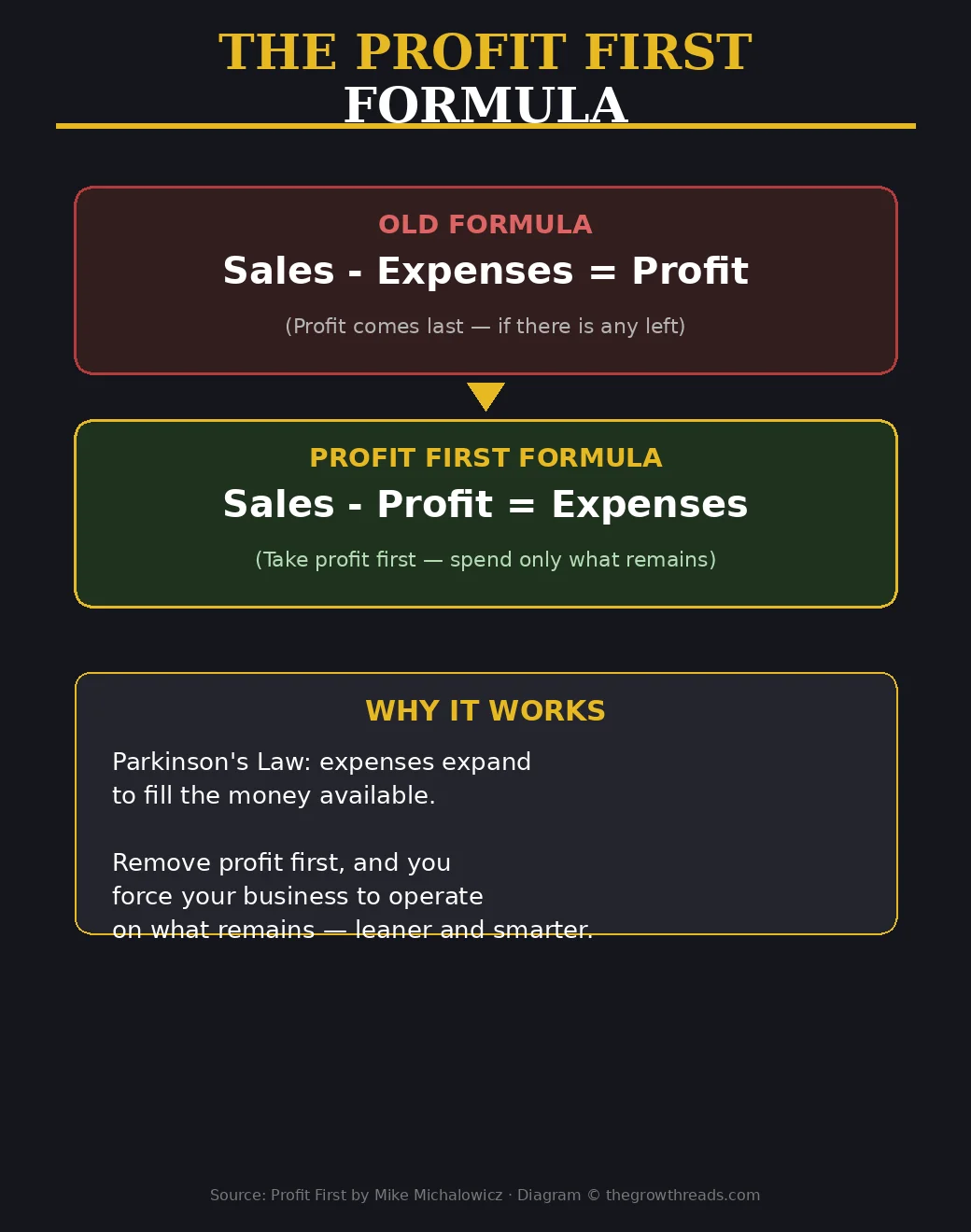
Flip the accounting formula: take your profit first, then spend what is left. Mike Michalowicz argues that the traditional formula — Sales minus Expenses equals Profit — guarantees that profit comes last, if it comes at all. His Profit First system reverses it: Sales minus Profit equals Expenses. By removing profit from revenue before paying any bills, you force your business to operate on what remains, harnessing Parkinson’s Law (expenses expand to fill the money available) to make your business leaner, smarter, and permanently profitable. The mechanics are simple: five dedicated bank accounts, percentage-based allocations, and a twice-monthly rhythm of transfers.
Key takeaways
- The traditional formula guarantees profit comes last: Sales – Expenses = Profit means profit is whatever crumbs remain after expenses eat their fill. Most small businesses have zero or negative profit because expenses always find a way to consume revenue.
- Flip the formula: Sales – Profit = Expenses. By removing profit first, you cap expenses at what remains, forcing frugality and innovation rather than bloat.
- Parkinson’s Law is the engine: Work (and spending) expand to fill the resources available. Give your business less to spend, and it will find ways to operate on less — without sacrificing quality.
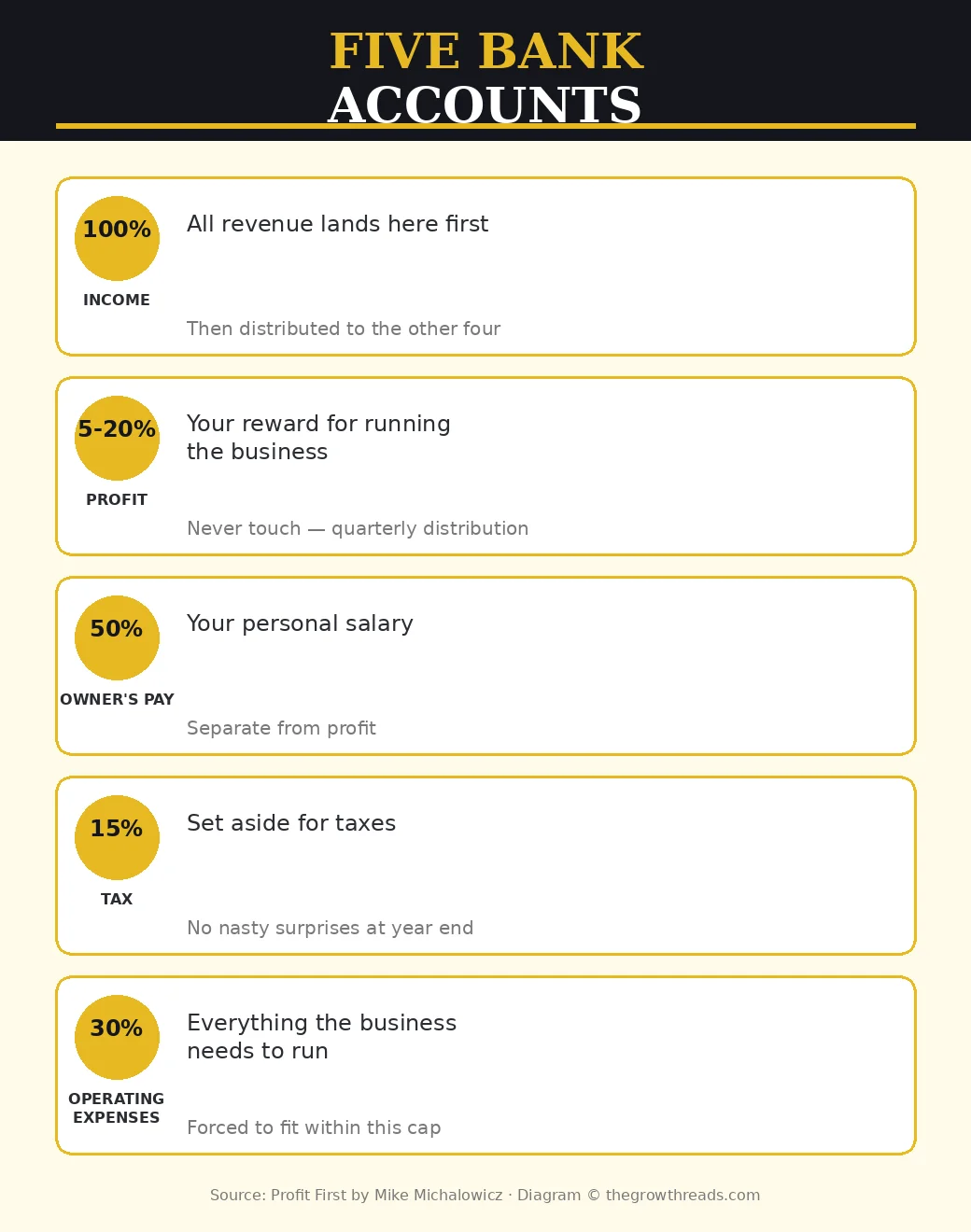
- Use five bank accounts: Income (revenue lands here), Profit (5–20%), Owner’s Pay (~50%), Tax (~15%), and Operating Expenses (~30%). The exact percentages depend on your revenue tier.
- Transfer twice monthly on the 10th and 25th: Move money from Income to the four allocation accounts on a fixed schedule. This rhythm prevents cash-flow surprises and creates discipline.
- Start with small percentages: If you currently take 0% profit, start at 1% and increase by 1–3% each quarter. Gradual shifts let the business adapt without shock.
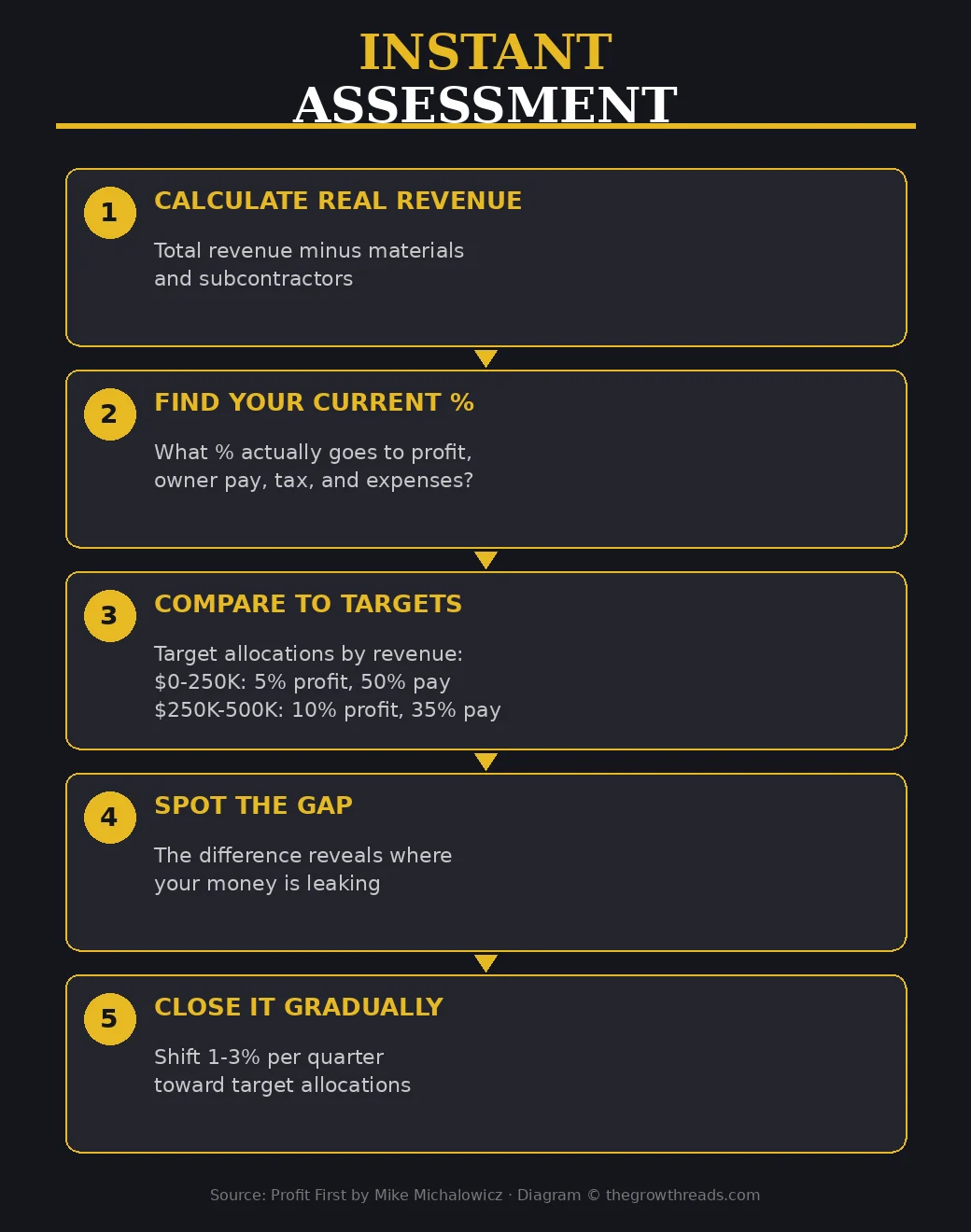
- Real Revenue is your true top line: Subtract materials and subcontractors from total revenue to get Real Revenue — the number your allocation percentages should be based on.
- The Instant Assessment reveals the truth: Compare your current allocation percentages to the target percentages for your revenue tier. The gap shows exactly where money is leaking.
- Profit distributions are quarterly rewards: Every quarter, take 50% of the Profit account as a personal reward. The other 50% stays as a cash reserve. This ritual makes profitability tangible and motivating.
- Cut expenses by asking one question: For every expense, ask: “Can I get the same or better result for less or for free?” Most businesses find 10–30% in savings within the first quarter.
What is Profit First about?
Profit First is a cash-management system for small businesses that reverses the traditional accounting formula. Instead of treating profit as whatever remains after expenses, it allocates profit first — using separate bank accounts and fixed percentages — then forces the business to operate on what is left. The result is permanent, built-in profitability from day one.
About the author
Mike Michalowicz is a serial entrepreneur who built and sold two multimillion-dollar companies before age 35, then lost everything through reckless spending. That experience became the catalyst for Profit First. He is the author of six business books, including The Pumpkin Plan, Clockwork, and Fix This Next. Michalowicz is a former small-business columnist for The Wall Street Journal, a regular on MSNBC’s Your Business, and a popular keynote speaker on entrepreneurship. His Profit First system has been adopted by hundreds of thousands of businesses and is supported by a network of certified Profit First professionals worldwide. Explore all Mike Michalowicz book summaries →
Key concepts at a glance
| Concept | What it means | Use it when |
|---|---|---|
| Profit First formula | Sales – Profit = Expenses (reversed from traditional) | You want to guarantee profitability, not hope for it |
| Parkinson’s Law | Expenses expand to fill available resources | You need to understand why revenue growth has not made you more profitable |
| Five accounts | Income, Profit, Owner’s Pay, Tax, Operating Expenses | You want the mechanical structure for implementing the system |
| Real Revenue | Total revenue minus materials and subcontractors | You need the correct base number for calculating allocation percentages |
| Instant Assessment | Comparing current vs. target allocation percentages | You want to diagnose exactly where money is leaking in your business |
| Target Allocation Percentages (TAPs) | Revenue-tier-specific targets for each account | You need to know what “healthy” looks like for your business size |
| Quarterly profit distribution | Taking 50% of profit account as a personal reward every quarter | You want to make profitability tangible and emotionally real |
Part 1: Why the old formula fails
Michalowicz opens with a confession: despite building two companies that generated millions in revenue, he was broke. Revenue grew, but expenses grew faster — bigger offices, more staff, fancier tools. He was caught in what he calls the “Survival Trap”: always chasing the next sale to cover the last expense.
The root cause, he argues, is the traditional accounting formula taught in every business school: Sales – Expenses = Profit. This formula treats profit as a leftover — a residual that appears only after every expense has been satisfied. In practice, expenses always expand to consume available revenue (Parkinson’s Law), leaving profit at zero or below.
Michalowicz draws an analogy to the plate-size studies by nutrition researcher Brian Wansink: when people are given larger plates, they serve themselves more food without realising it. The same thing happens with bank accounts. When all revenue sits in one large account, every expense feels affordable. The solution is smaller plates — or in business terms, smaller, purpose-specific accounts that limit how much is available for spending.
Part 2: The five-account system
The mechanical core of Profit First is five bank accounts, each serving a single purpose. All revenue flows into the Income account first — this is the collection point. On the 10th and 25th of each month, you transfer fixed percentages from Income into the other four accounts.
The Profit account receives 5–20% of Real Revenue (depending on your revenue tier). This money is never used for operations. Every quarter, you distribute 50% as a personal reward — a tangible reminder that the business exists to serve you, not the other way around. The other 50% stays as a cash reserve.
The Owner’s Pay account covers your personal salary. Michalowicz recommends targeting around 50% of Real Revenue for solo businesses, scaling down as the business grows and adds team members.
The Tax account holds roughly 15% (adjusted for your tax bracket and jurisdiction). The purpose is to eliminate the panic of tax season by pre-funding your obligations throughout the year.
The Operating Expenses account gets whatever remains — typically around 30%. This is the “smaller plate” that forces your business to find efficiency. If operating expenses currently consume 65% of revenue and you are targeting 30%, you close the gap gradually — 1–3 percentage points per quarter — giving the business time to adapt.
Part 3: The Instant Assessment
Before implementing Profit First, Michalowicz walks you through the Instant Assessment — a diagnostic that reveals exactly where your money is going. The process takes about 30 minutes and requires only your last 12 months of financial statements.
First, calculate your Real Revenue: total revenue minus materials, subcontractors, and any pass-through costs. This is the money your business actually earns through its own efforts. Then, calculate what percentage of Real Revenue currently goes to each category: profit, owner’s pay, tax, and operating expenses.
Compare your current percentages to the Target Allocation Percentages (TAPs) for your revenue tier. Michalowicz provides benchmark tables: a business earning $0–250K in Real Revenue should target 5% profit, 50% owner’s pay, 15% tax, and 30% operating expenses. As revenue grows, profit percentage increases (up to 20%) while owner’s pay as a percentage decreases (the absolute amount still rises).
The gap between your current allocations and the targets reveals where money is leaking. Most businesses discover that operating expenses are dramatically higher than target — often 60–80% of revenue instead of the target 30%. The fix is not an overnight slash; it is a gradual reallocation of 1–3 percentage points per quarter, creating sustainable change without disrupting operations.
Part 4: Cutting the fat and growing lean
With reduced operating expense allocations, businesses are forced to find efficiencies. Michalowicz provides a systematic approach: review every line item and ask, “Can I get the same or better result for less or for free?” He shares case studies of businesses that cut 10–30% of expenses within a single quarter without reducing output quality — often by renegotiating contracts, eliminating redundant subscriptions, and replacing high-cost tools with simpler alternatives.
He also challenges the “grow revenue to grow profit” assumption. Many businesses try to outgrow their expense problem — adding revenue without fixing the underlying spending pattern. This is like trying to outrun a leaking bucket. Profit First forces you to fix the leak first, so that every dollar of new revenue actually contributes to the bottom line.
Michalowicz closes by addressing the emotional side of the system. The quarterly profit distribution — even if it starts at a modest amount — is psychologically powerful. It proves that the business can be profitable, which shifts the owner’s identity from “survivor” to “business owner who takes profit.” That identity shift, he argues, is what sustains the system long-term.
Who is Profit First best for — and who should read something else first?
This book is ideal for small-business owners, solopreneurs, and freelancers earning between $100K and $5M in revenue who feel like they are working harder than ever but have nothing to show for it financially. It is especially useful for creative businesses, agencies, and service providers who confuse revenue with profit. The system works at any revenue level — Michalowicz has seen it applied to side hustles earning $2K/month and firms earning $30M/year.
If you are looking for personal (not business) money management, try I Will Teach You to Be Rich or The Total Money Makeover. If your business challenge is more about operations and scaling than cash management, The Lean Startup or Good to Great may be more relevant.
Questions to reflect on
- What percentage of your revenue actually becomes profit right now — and does that number surprise you?
- Which expenses would you cut first if you had to reduce operating costs by 10% this quarter?
- When was the last time you took a deliberate financial reward from your business that was not just covering bills?
- Are you trying to outgrow your expense problem rather than fixing the leak?
- What would change in your business decisions if you knew profit was already taken care of?
🔥 Ready to make your business permanently profitable?
Learn the five-account system that guarantees profit from your very next deposit.
How to apply Profit First (7-day plan)
- Day 1 — Run your Instant Assessment: Pull the last 12 months of revenue and expenses. Calculate Real Revenue. Determine your current allocation percentages for profit, owner’s pay, tax, and operating expenses.
- Day 2 — Set your target percentages: Look up the TAPs for your revenue tier in the book. Write down the gap between current and target for each category.
- Day 3 — Open two new bank accounts: Start with just two: a Profit account and a Tax account at a different bank (out of sight, out of mind). You can add Owner’s Pay and Operating Expenses accounts later.
- Day 4 — Make your first allocation: Transfer 1% of current revenue to the Profit account and 1% to the Tax account. It does not matter how small — the habit matters more than the amount.
- Day 5 — Review your expenses: Go through every recurring expense and ask: “Can I get the same result for less or free?” Flag three items to renegotiate or cancel this month.
- Day 6 — Set calendar reminders: Schedule recurring transfers for the 10th and 25th of each month. Automate where your bank allows it.
- Day 7 — Plan your first profit distribution: Mark your calendar 90 days from now. On that date, take 50% of whatever has accumulated in your Profit account and use it for something you enjoy. This is the moment the system becomes real.
Frequently asked questions
What is the Profit First formula?
The traditional formula is Sales – Expenses = Profit. Profit First reverses it: Sales – Profit = Expenses. You allocate profit (and owner’s pay and tax) from revenue first, then spend only what remains on operations. This harnesses Parkinson’s Law — the tendency for expenses to expand to fill available resources — by giving the business less to spend.
Does Profit First work for very small businesses?
Yes. Michalowicz designed it specifically for small businesses and solopreneurs. The system works at any revenue level — even side hustles earning a few thousand dollars per month. The percentages scale to your revenue tier, and the core principle (take profit first, spend the rest) applies regardless of business size. Many Profit First success stories come from businesses earning under $500K annually.
What are the five bank accounts in Profit First?
Income (where all revenue lands first), Profit (5–20% of Real Revenue, never used for operations), Owner’s Pay (your personal salary, around 50% for small businesses), Tax (approximately 15%, pre-funded throughout the year), and Operating Expenses (everything the business needs to run, typically 30%). Michalowicz recommends keeping Profit and Tax at a separate bank to reduce the temptation to raid them.
What is the Instant Assessment?
A diagnostic exercise that takes about 30 minutes. You calculate your Real Revenue (total revenue minus materials and subcontractors), then determine what percentage currently goes to profit, owner’s pay, tax, and operating expenses. Comparing these to the Target Allocation Percentages for your revenue tier reveals exactly where money is leaking and how far you are from healthy allocations.
How long does it take to implement Profit First?
The basic setup — opening accounts and making your first transfers — takes less than a week. Reaching your target allocation percentages typically takes 6–18 months, depending on how far your current numbers are from the targets. Michalowicz recommends shifting 1–3 percentage points per quarter, which gives the business time to adapt without causing cash-flow stress.
How does Profit First compare to traditional budgeting?
Traditional budgeting tells you how much you plan to spend in each category and then hopes you stick to the plan. Profit First removes the need for budgeting discipline by structuring the bank accounts so that money for profit, tax, and pay is physically separated before expenses can touch it. It replaces willpower with architecture — which is why it tends to work where budgets fail.
Is Profit First worth reading in 2026?
Absolutely. The revised and expanded edition (2017) is well-maintained, and the system’s simplicity means it has not dated. The Profit First community has grown to include thousands of certified professionals, making implementation support widely available. If you run any kind of small business and struggle with profitability despite decent revenue, this is one of the most practical books you can read.
Related summaries
- I Will Teach You to Be Rich Summary — The personal-finance equivalent of Profit First: automate your money into purpose-specific accounts.
- The Total Money Makeover Summary — Dave Ramsey’s debt-elimination system using baby steps and cash envelopes.
- Secrets of the Millionaire Mind Summary — The mindset blueprint behind money habits, featuring a similar six-jar allocation system.
- The Lean Startup Summary — Eric Ries on building lean, efficient businesses through validated learning.
- See all money book summaries on our Best Money Books pillar page.
Related Money Summaries
The Black Swan Summary and Review
The Little Book of Common Sense Investing Summary & Review: The Only Investment Guide You Will Ever Need
The Millionaire Fastlane Summary & Review: Build Wealth Fast
The Millionaire Mind Summary & Review: What Self-Made Millionaires Actually Think
The Most Important Thing Summary & Review: Uncommon Sense for Thoughtful Investors