

★★★★☆ 4.0 / 5 — A witty, research-packed tour of your brain’s worst predictions about what will make you happy.
Best for: Anyone who has achieved a goal and felt oddly unchanged — or dreaded something that turned out fine.
Reading time: ~6 hours (263 pages)
Difficulty to apply: Medium. The ideas are eye-opening, but overriding hardwired prediction errors requires constant practice.
Stumbling on Happiness in one minute
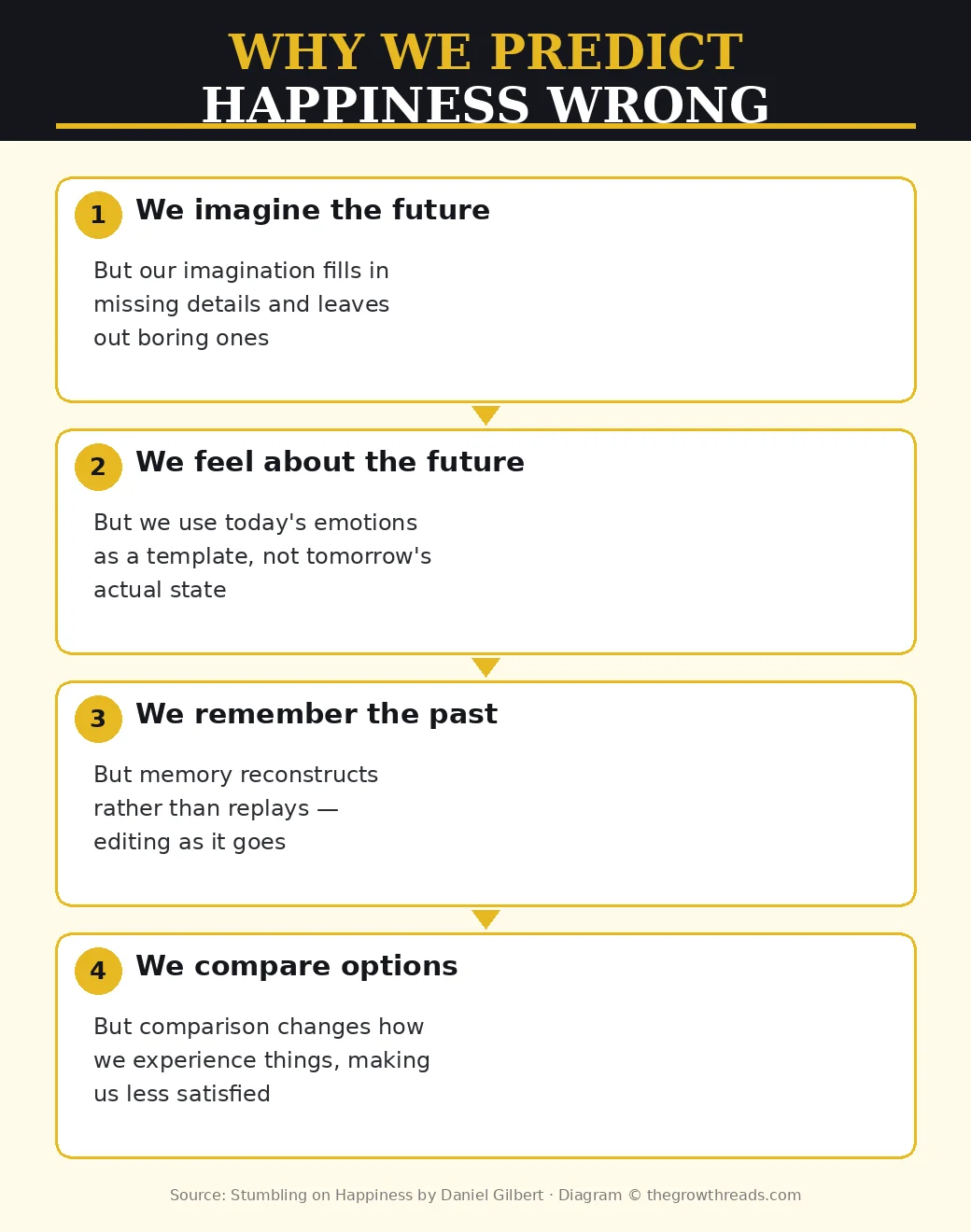
Your brain is a prediction machine — and it is spectacularly bad at forecasting what will make you happy. Harvard psychologist Daniel Gilbert synthesises decades of research in psychology, cognitive neuroscience, philosophy, and behavioural economics to show that humans systematically misjudge their future emotions. We fill in details that will not exist, leave out details that will, project our current feelings onto tomorrow, and underestimate our own resilience. The result: we chase things that will not satisfy us and avoid things that would. Gilbert argues the single best shortcut is “surrogation” — asking people who are currently experiencing the thing you are considering, rather than trusting your own imagination.
Key takeaways
- Imagination is flawed by design: When you picture the future, your brain fills in details (often wrong ones) and leaves out mundane realities. The mental movie is always a highlights reel, never a documentary.
- Presentism distorts predictions: Your current emotional state colours everything you imagine about the future. Hungry? You will overestimate how much food you will want at tomorrow’s buffet. Happy? You will struggle to imagine ever feeling sad again.
- Impact bias is universal: People consistently overestimate both the intensity and the duration of their emotional reactions to future events — positive and negative.
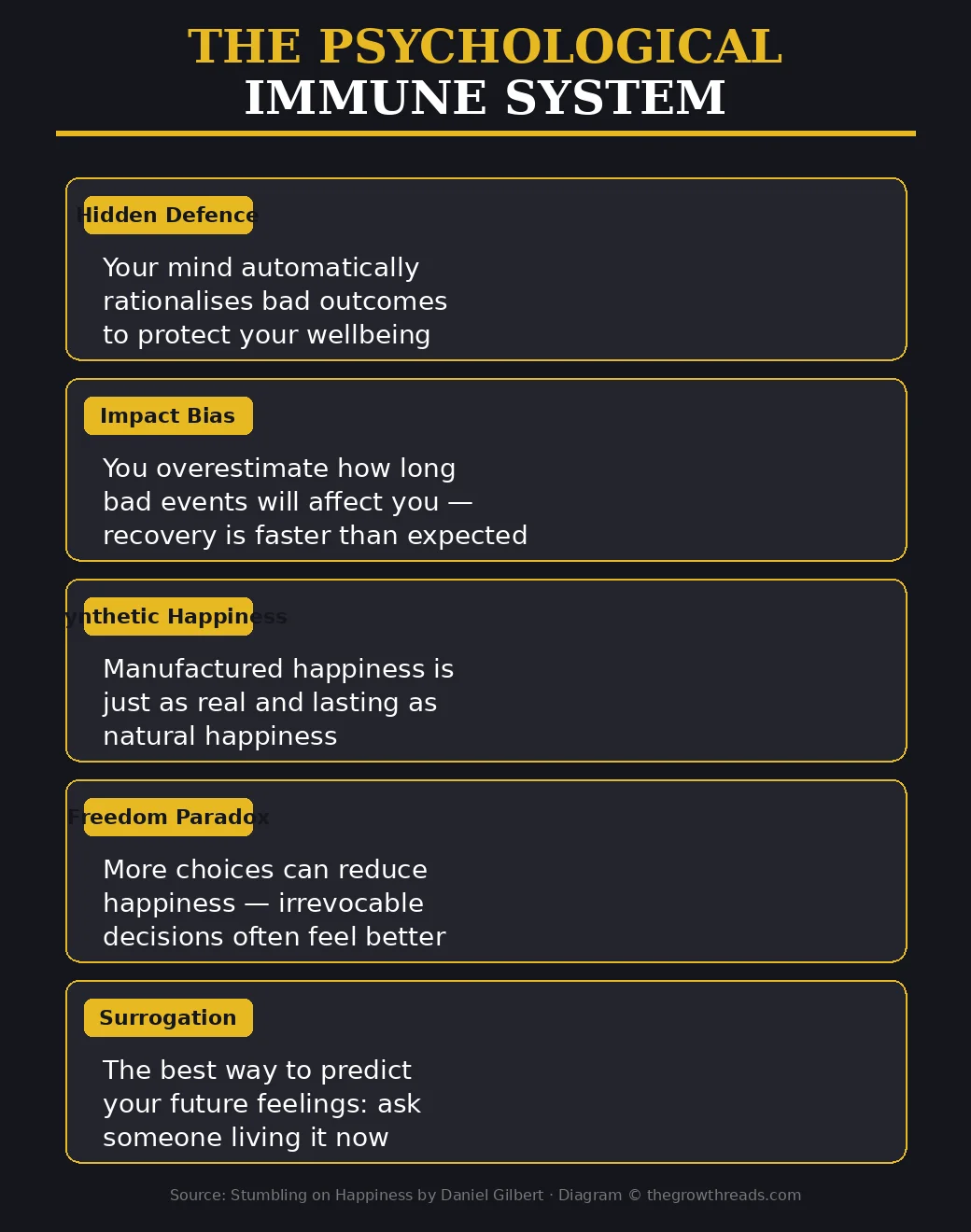
- The psychological immune system is real: Your mind has a hidden defence system that rationalises, reframes, and reinterprets bad outcomes to help you recover. You are far more emotionally resilient than you think.
- Synthetic happiness is genuine happiness: The happiness you manufacture after things go wrong is neurologically identical to the happiness you feel when things go right. It is not “settling” — it is adapting.
- More choice can reduce satisfaction: Irrevocable decisions tend to produce more satisfaction than reversible ones, because your psychological immune system kicks in only when there is no escape route.
- Memory is reconstruction, not replay: You do not remember experiences accurately — you edit them, compress them, and weight the ending disproportionately. This biased memory then becomes the raw material for future predictions.
- Comparison changes experience: How you experience something depends enormously on what you compare it to. The same salary feels wonderful or terrible depending on what your neighbour earns.
- Surrogation beats imagination: The most reliable way to predict how you will feel in a situation is to ask someone who is currently in that situation — not to simulate it in your head.
- We resist surrogation because we believe we are unique: People refuse to use this simple shortcut because they believe their emotional reactions will differ from everyone else’s. They rarely do.
What is Stumbling on Happiness about?
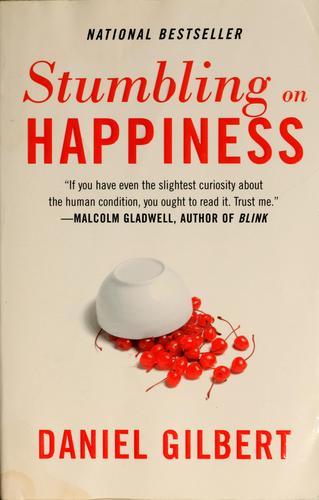
Stumbling on Happiness is a psychology book that examines why humans are poor predictors of their own future happiness. Drawing on research in affective forecasting, cognitive bias, and neuroscience, Daniel Gilbert reveals the systematic errors our brains make when imagining what will please or pain us — and offers one practical corrective: surrogation.
About the author
Daniel Gilbert is Edgar Pierce Professor of Psychology at Harvard University, where he has taught since 1996. His research on affective forecasting — how people predict their future emotional states — earned him a Guggenheim Fellowship and the American Psychological Association’s Distinguished Scientific Award for an Early Career Contribution. His TED talks on happiness have been viewed over 20 million times. Stumbling on Happiness won the Royal Society Prize for Science Books in 2007, beating out works by Richard Dawkins and others. Gilbert is also a contributor to The New York Times and has hosted the PBS television series This Emotional Life. Explore all Daniel Gilbert book summaries →
Key concepts at a glance
| Concept | What it means | Use it when |
|---|---|---|
| Affective forecasting | Predicting how you will feel in the future | You are about to make a major life decision based on how you think it will feel |
| Impact bias | Overestimating the emotional impact of future events | You are dreading or desperately wanting something and need perspective |
| Presentism | Using current feelings to predict future feelings | You notice yourself making decisions while hungry, tired, or emotional |
| Psychological immune system | Your mind’s automatic defence against unhappiness | You fear a worst-case scenario and need to remember you will adapt |
| Synthetic happiness | Happiness manufactured after an outcome rather than found in it | You need reassurance that “making the best of it” is not second-best |
| Surrogation | Using other people’s current experience to predict your own future feelings | You are imagining a future scenario and want a reliable reality check |
| Filling in / Leaving out | Imagination adds details that will not exist and omits details that will | You are fantasising about (or dreading) a future situation in vivid detail |
| Immune neglect | Failing to anticipate your own psychological resilience | You believe a negative event will ruin you permanently |
Part 1: Prospection — the brain’s time machine
Gilbert opens by establishing that humans are the only animals that think about the future in rich, vivid detail — a capacity he calls “prospection.” The frontal lobe, which expanded dramatically in human evolution, is essentially a future-simulation machine. We spend an enormous portion of our waking hours imagining what is coming next — what we will eat for dinner, how a job interview will go, what retirement will feel like.
This ability is our greatest cognitive gift, but it comes with a fatal flaw: the simulations are unreliable. Gilbert uses the metaphor of a flight simulator. A pilot’s simulator is calibrated against real physics; your brain’s simulator is calibrated against your current mood, your limited memory, and your unconscious assumptions. The result is a mental preview that feels convincing but is systematically wrong.
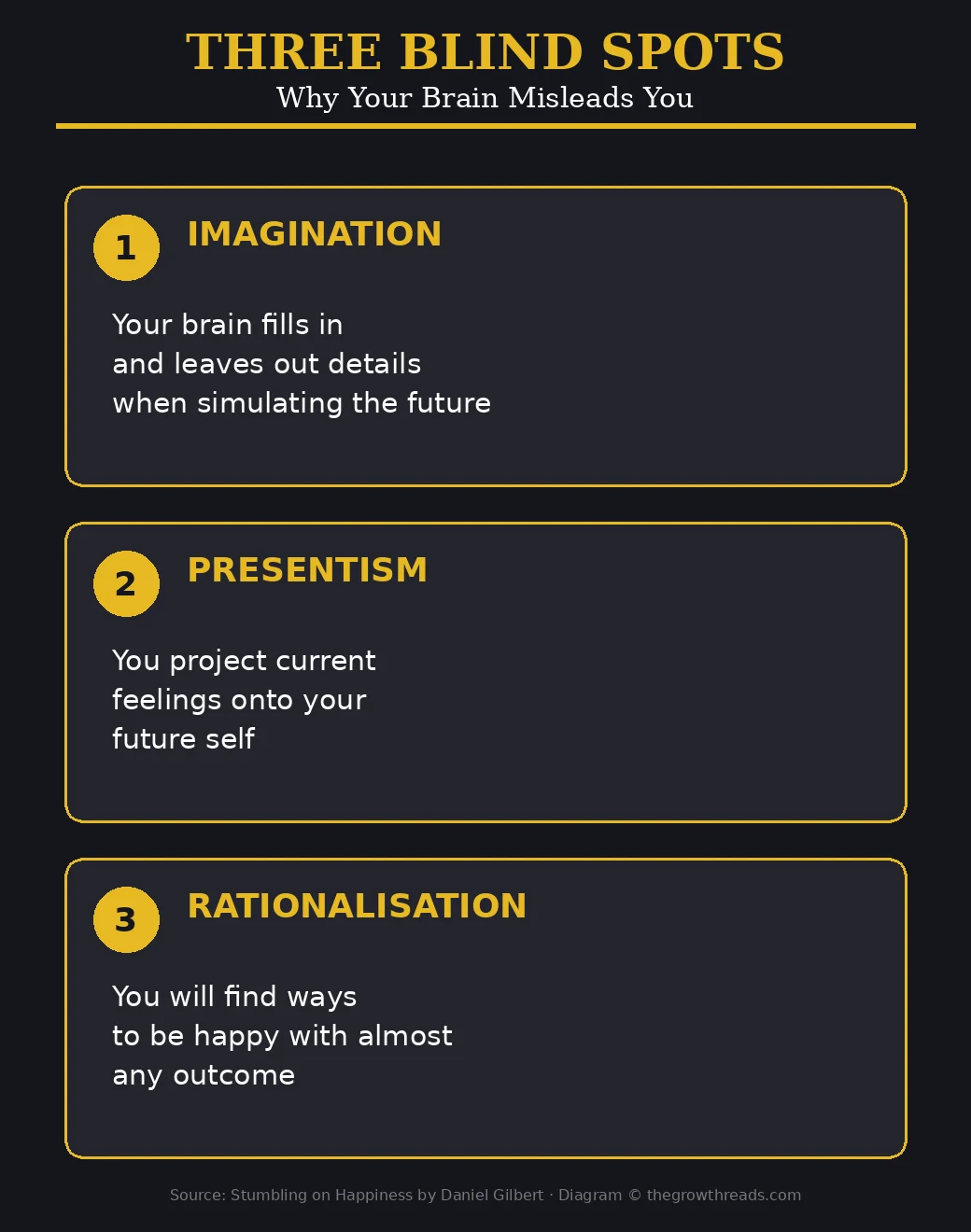
He introduces three specific errors that the simulator makes. First, filling in — when you imagine the future, your brain adds details that may never materialise (the adoring crowd at your book launch, the perfect weather on your vacation). Second, leaving out — your brain omits the mundane realities that will dominate the actual experience (the commute to the new job, the tax paperwork after the windfall). Third, focusing illusion — whatever you are thinking about at the moment of prediction looms disproportionately large in your imagined future.
Part 2: Presentism and the illusion of continuity
Gilbert devotes several chapters to what he calls “presentism” — the tendency to use your current emotional state as a lens for viewing the future. When you are full, you cannot imagine being hungry. When you are in love, you cannot imagine the relationship ending. When you are miserable, you cannot imagine ever feeling joy again.
This is not mere pessimism or optimism — it is a hardwired cognitive limitation. Studies show that shoppers who are hungry buy more food than they can eat, that people who are currently warm underestimate how uncomfortable they would be in the cold, and that medical patients in acute pain dramatically overrate how much pain they will feel in a week.
Gilbert extends this to show that the person you are right now is a poor proxy for the person you will be in five or ten years. Your tastes, values, and priorities will shift in ways you currently cannot imagine — a phenomenon he supports with research showing that people of every age expect to change very little in the future despite acknowledging that they have changed enormously in the past. He calls this the “end of history illusion.”
The practical implication is stark: when you make a ten-year plan based on what you want today, you are designing a life for a stranger. The person who will live that life will have different preferences, and you have no reliable way to anticipate them.
Part 3: The psychological immune system
The most counterintuitive section of the book introduces the “psychological immune system” — an unconscious set of cognitive processes that defend you against unhappiness. Just as your biological immune system fights infections you never consciously detect, your psychological immune system rationalises, reframes, and reinterprets negative events to reduce their emotional impact.
Gilbert presents compelling evidence: people who become paraplegic report levels of happiness close to their pre-accident baseline within a year. People who lose elections, get rejected from dream schools, or endure painful breakups recover far faster than they or anyone else would have predicted. The immune system works through mechanisms like rationalisation (“it was for the best”), dissonance reduction (“I did not want that anyway”), and positive reappraisal (“this made me stronger”).
Crucially, Gilbert distinguishes between natural happiness (getting what you want) and synthetic happiness (making the best of what you get). Most people treat synthetic happiness as inferior — a consolation prize. Gilbert’s research shows it is neurologically indistinguishable from natural happiness. The brain cannot tell the difference, and neither can your subjective experience.
This leads to the freedom paradox: people who have fewer options often end up happier than people who have many. When a decision is irrevocable — you cannot return the item, you cannot switch partners — your psychological immune system activates and helps you love what you have. When the decision is reversible, the immune system stays dormant, and you spend your time wondering whether you made the right choice.
Part 4: Surrogation — the one fix that works
After spending most of the book demolishing your confidence in your own predictions, Gilbert offers a single practical solution: surrogation. Instead of imagining how you will feel in a future situation, find someone who is already in that situation and ask them how they feel.
Want to know if you will enjoy living in a new city? Ask people who recently moved there. Wondering if having a third child will make you happier? Ask parents of three. Considering a career change? Talk to someone who made the same switch.
Gilbert acknowledges that this advice sounds obvious and that people almost universally reject it. The reason, he argues, is our deep belief in our own uniqueness. We assume our emotional reactions will differ from other people’s. Study after study shows they rarely do. People are far more similar in their emotional responses than they believe, and surrogation consistently outperforms personal imagination as a forecasting tool.
The irony Gilbert closes with: the very biases he has spent the entire book exposing make it nearly impossible for readers to act on this advice. Even after learning about impact bias, presentism, and immune neglect, you will still trust your own flawed imagination over other people’s lived experience. Knowing about the bug does not fix the bug — it simply makes you a more informed victim of it.
Who is Stumbling on Happiness best for — and who should read something else first?
This book is ideal for intellectually curious readers who enjoy having their assumptions challenged by rigorous research. If you are a fan of Malcolm Gladwell, Dan Ariely, or Daniel Kahneman, Gilbert’s writing will feel familiar — smart, funny, and packed with experiments. It is also valuable for anyone standing at a major crossroads (career change, relocation, relationship decision) who wants to understand why their gut feeling about the outcome is probably wrong.
If you are looking for a step-by-step happiness programme, this is not the right book. Gilbert diagnoses the problem more than he prescribes solutions. For actionable daily habits, try Atomic Habits or The Power of Habit. For a philosophical approach to happiness rooted in Stoicism and Adlerian psychology, see The Courage to Be Disliked.
Questions to reflect on
- Think of a time you dreaded something that turned out fine. What does that tell you about your prediction accuracy?
- What major decision are you currently projecting your present emotional state onto?
- If you asked someone already living the life you are considering, what would they say that your imagination has not accounted for?
- When has an irrevocable decision (no take-backs) turned out to feel better than one where you kept your options open?
- What is one area of your life where you could use surrogation instead of imagination this week?
🔥 Ready to outsmart your own prediction machine?
Learn why your brain lies about the future — and the one hack that actually works.
How to apply Stumbling on Happiness (7-day plan)
- Day 1 — Catch your imagination filling in: Choose one upcoming event and write down what you imagine it will be like. Note every detail. After the event, compare your prediction to reality and circle what your brain added that was not there.
- Day 2 — Test presentism: Make a prediction about how you will feel this weekend while you are in a specific mood (tired, excited, stressed). Write it down. Then check on the weekend — was the prediction coloured by today’s emotion?
- Day 3 — Try surrogation: Identify one decision you are currently weighing. Find one person already living with that choice and ask them three questions: what is the best part, the worst part, and what surprised them?
- Day 4 — Measure your impact bias: Think of the last bad thing that happened to you. How long did you expect to feel terrible? How long did you actually feel terrible? Note the gap.
- Day 5 — Embrace irrevocability: Make one small decision today and commit to it with no option to reverse. Notice whether closure brings relief rather than anxiety.
- Day 6 — Audit your comparisons: Identify one area where you are comparing yourself to others (salary, house, career stage). Remove or reduce exposure to that comparison for 24 hours and notice how your satisfaction changes.
- Day 7 — Write a letter to your future self: Describe what you think will make you happy in five years. Seal it. You will be surprised when you open it at how much your preferences have shifted — proof of the end-of-history illusion.
Frequently asked questions
Is Stumbling on Happiness a self-help book?
Not in the traditional sense. Gilbert describes it as a book about why we are bad at predicting happiness, not a manual for achieving it. The tone is closer to a popular science book — full of research studies, wit, and counterintuitive findings — than a prescriptive guide. That said, understanding the biases Gilbert describes can meaningfully improve your decision-making, which is itself a form of self-improvement.
What is the main argument of Stumbling on Happiness?
Humans are uniquely able to imagine the future, but this ability is riddled with systematic errors. We fill in wrong details, project our current feelings forward, underestimate our resilience, and let comparisons distort our experience. The single most reliable fix is surrogation — using other people’s current experiences to predict your own future feelings — but we resist it because we overestimate our uniqueness.
What is the psychological immune system?
It is Daniel Gilbert’s term for the unconscious cognitive processes that protect you from sustained unhappiness. Just as your biological immune system fights illness, your psychological immune system rationalises bad outcomes, reframes negative events, and manufactures contentment. This “synthetic happiness” is neurologically indistinguishable from the happiness you feel when you get what you want.
What is impact bias?
Impact bias is the tendency to overestimate both the intensity and duration of your emotional reactions to future events. You predict that winning the promotion will make you ecstatic for months (it wears off in weeks) and that losing your job will devastate you permanently (you adapt faster than expected). Gilbert shows that this bias is one of the most robust findings in happiness research.
How does Stumbling on Happiness compare to Thinking, Fast and Slow?
Both books reveal cognitive biases backed by rigorous research, but they focus on different domains. Kahneman covers a broad range of thinking errors — anchoring, loss aversion, base-rate neglect — across many decision contexts. Gilbert zooms in specifically on emotional prediction: why we are bad at forecasting our own happiness. Kahneman’s book is more comprehensive; Gilbert’s is more focused and funnier. They complement each other beautifully.
What is surrogation and why don’t people use it?
Surrogation means predicting your future feelings by asking someone currently in the situation you are considering. Instead of imagining how you will feel living in London, you ask someone who recently moved there. Research shows this method far outperforms imagination, but people refuse to use it because they believe they are uniquely different from others. Gilbert’s data shows this belief is almost always wrong.
Is Stumbling on Happiness worth reading in 2026?
Absolutely. The research on affective forecasting, impact bias, and the psychological immune system has only been strengthened by subsequent studies. Gilbert’s core argument — that your imagination is a poor guide to your future feelings — is as relevant as ever, especially in an age of social-media comparison and infinite choice. The writing holds up well, and the book remains one of the most accessible introductions to the science of happiness.
Related summaries
- Thinking, Fast and Slow Summary — The comprehensive guide to cognitive biases that shape every decision.
- The Courage to Be Disliked Summary — An Adlerian take on why happiness is a choice, not a destination.
- Dopamine Nation Summary — The neuroscience of pleasure, pain, and why anticipation beats consumption.
- Predictably Irrational Summary — Dan Ariely on the hidden forces that shape our decisions.
- See all psychology book summaries on our Best Psychology Books pillar page.
Related Psychology Summaries
Influence Summary & Review: The Psychology of Persuasion
Man’s Search for Meaning Summary & Review: Finding Purpose in Any Circumstance
Originals Summary & Review: How Non-Conformists Move the World
Outliers Summary & Review: Why Success Is Never a Solo Act
Why Has Nobody Told Me This Before? Summary & Review: Your Mental Health Toolkit