

★★★★☆ 3.9 / 5 — A punchy, no-fluff playbook for rewiring your relationship with money.
Best for: Anyone who suspects their beliefs about money — not their income — are holding them back.
Reading time: ~4 hours (224 pages)
Difficulty to apply: Low-to-medium. The exercises are concrete, but changing lifelong mental habits takes sustained awareness.
Secrets of the Millionaire Mind in one minute
Your financial thermostat is set in childhood, and unless you reset it, no amount of hustle changes the outcome. T. Harv Eker argues that every person has an internal “money blueprint” — a preset level of wealth their subconscious believes they deserve. This blueprint was programmed by parents, culture, and early experiences. The book walks you through identifying your blueprint, replacing limiting “wealth files” with empowering ones, and installing a practical money-management system (the six-jar method) that forces the right habits regardless of income level. Eker’s premise is simple: thoughts lead to feelings, feelings lead to actions, actions lead to results. Change the inner game and the outer game follows.
Key takeaways
- Your money blueprint determines your financial life: Like a thermostat, your subconscious has a preset “comfort zone” for wealth. Lottery winners go broke and entrepreneurs bounce back because of their blueprints, not luck.
- Thoughts → Feelings → Actions → Results: Eker calls this the Process of Manifestation. Changing your financial results starts with changing the thoughts that drive them.
- Three sources programmed your blueprint: Verbal programming (what you heard about money growing up), modelling (how the adults around you handled money), and specific incidents (emotional events tied to money).
- Rich people play to win; poor people play not to lose: The first “Wealth File” — a defensive posture toward money keeps you stuck in survival mode rather than building wealth.
- Rich people think “both”; poor people think “either/or”: You do not have to choose between being rich and being a good person, having wealth and having free time, or making money and doing work you love.
- Your income can only grow to the extent you do: Personal development and financial growth are directly linked — skills, mindset, and value creation all scale together.
- Rich people focus on net worth, not working income: Tracking savings, investments, and passive income matters more than your salary number.
- Manage your money with the six-jar system: Split every dollar into six dedicated accounts — Necessities (55%), Financial Freedom (10%), Education (10%), Long-Term Savings (10%), Play (10%), and Give (5%).
- Act in spite of fear: Wealthy people feel fear too — they simply refuse to let it make their decisions. Comfort is the enemy of growth.
- Constantly learn and grow: Eker’s final Wealth File — every dollar spent on education returns tenfold. The richest people he knows are the most committed learners.

What is Secrets of the Millionaire Mind about?
Secrets of the Millionaire Mind is a personal-finance and mindset book that argues your unconscious “money blueprint” — formed in childhood — controls how much wealth you accumulate. Eker provides 17 contrasting “Wealth Files” comparing how rich and poor people think, plus a hands-on money-management system to install better financial habits immediately.
About the author
T. Harv Eker grew up in Toronto with immigrant parents who struggled financially. After more than a dozen failed businesses in his twenties, he opened one of the first retail fitness stores in North America, grew it into a chain, and sold it to a Fortune 500 company. He later founded Peak Potentials Training, which delivered personal-development seminars to over 1.5 million people in 104 cities across the world. Eker’s own rags-to-riches trajectory — he went from zero to millionaire in only two and a half years — became the core case study behind Secrets of the Millionaire Mind, which debuted at number one on the New York Times bestseller list in 2005. Explore all T. Harv Eker book summaries →
Key concepts at a glance
| Concept | What it means | Use it when |
|---|---|---|
| Money blueprint | Your subconscious financial thermostat, set in childhood | You keep earning more but never getting ahead |
| Wealth Files | 17 contrasting beliefs that separate the wealthy from everyone else | You need a checklist for upgrading your money mindset |
| Process of Manifestation | Thoughts → Feelings → Actions → Results | You want to trace a financial outcome back to its root cause |
| Declarations | Spoken-aloud affirmations paired with a physical gesture | You want to rewire a specific limiting belief about money |
| Six-jar system | Splitting income into six purpose-driven accounts | You need a simple, autopilot money-management method |
| Financial Freedom Account | 10% of income invested solely to generate passive income | You want to build an asset base that eventually replaces your salary |
| Play Account | 10% spent guilt-free on luxuries and fun | You need balance so discipline doesn’t turn into deprivation |
| Verbal programming | The money messages you absorbed from parents and culture | You catch yourself repeating phrases like “money doesn’t grow on trees” |
Part 1: Your money blueprint
Eker opens with an observation most financial books skip: why do some people seem magnetically attracted to wealth while others — equally smart, equally hardworking — cycle through earning and losing? His answer is the money blueprint. Just as a house blueprint determines the structure of the building before a single nail is hammered, your internal financial blueprint determines the ceiling on your wealth before you earn a single dollar.
The blueprint is formed by three childhood mechanisms. First, verbal programming — every casual comment you heard about money (“rich people are greedy,” “we can’t afford that,” “money is the root of all evil”) etched a groove in your subconscious. Second, modelling — you watched your parents spend, save, argue about, or avoid money, and you either copied their pattern or rebelled against it (rebellion is still a reaction, not a free choice). Third, specific incidents — a traumatic or emotionally charged event involving money (a parent losing a job, a humiliating moment at a store) created a lasting emotional association.
Eker’s central metaphor is the thermostat. Set a room thermostat to 22°C, and the system fights to maintain that temperature — heating when it drops, cooling when it rises. Your financial thermostat works the same way. If your blueprint is set for $50,000 a year, you will unconsciously sabotage any earnings above that (overspending, bad investments, avoidance) and scramble to get back up if you fall below it. The only lasting solution is to reset the thermostat itself.
To do that, Eker introduces a four-step reprogramming process: (1) Awareness — recognise that your blueprint exists; (2) Understanding — see where it came from; (3) Disassociation — separate your identity from the outdated program; (4) Reconditioning — install new, empowering beliefs through declarations, modelling successful people, and changing your environment.
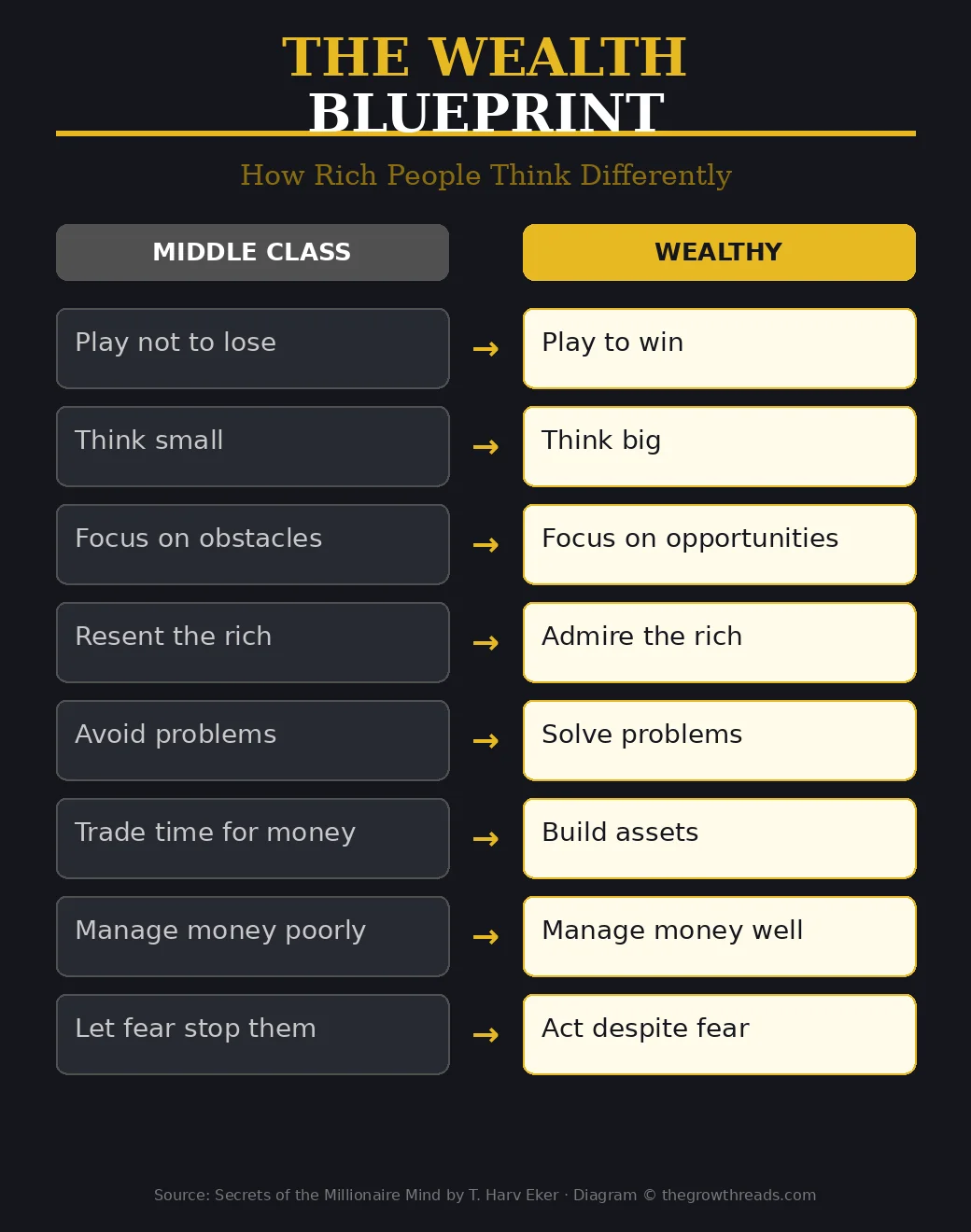
Part 2: The Wealth Files — 17 ways rich people think differently
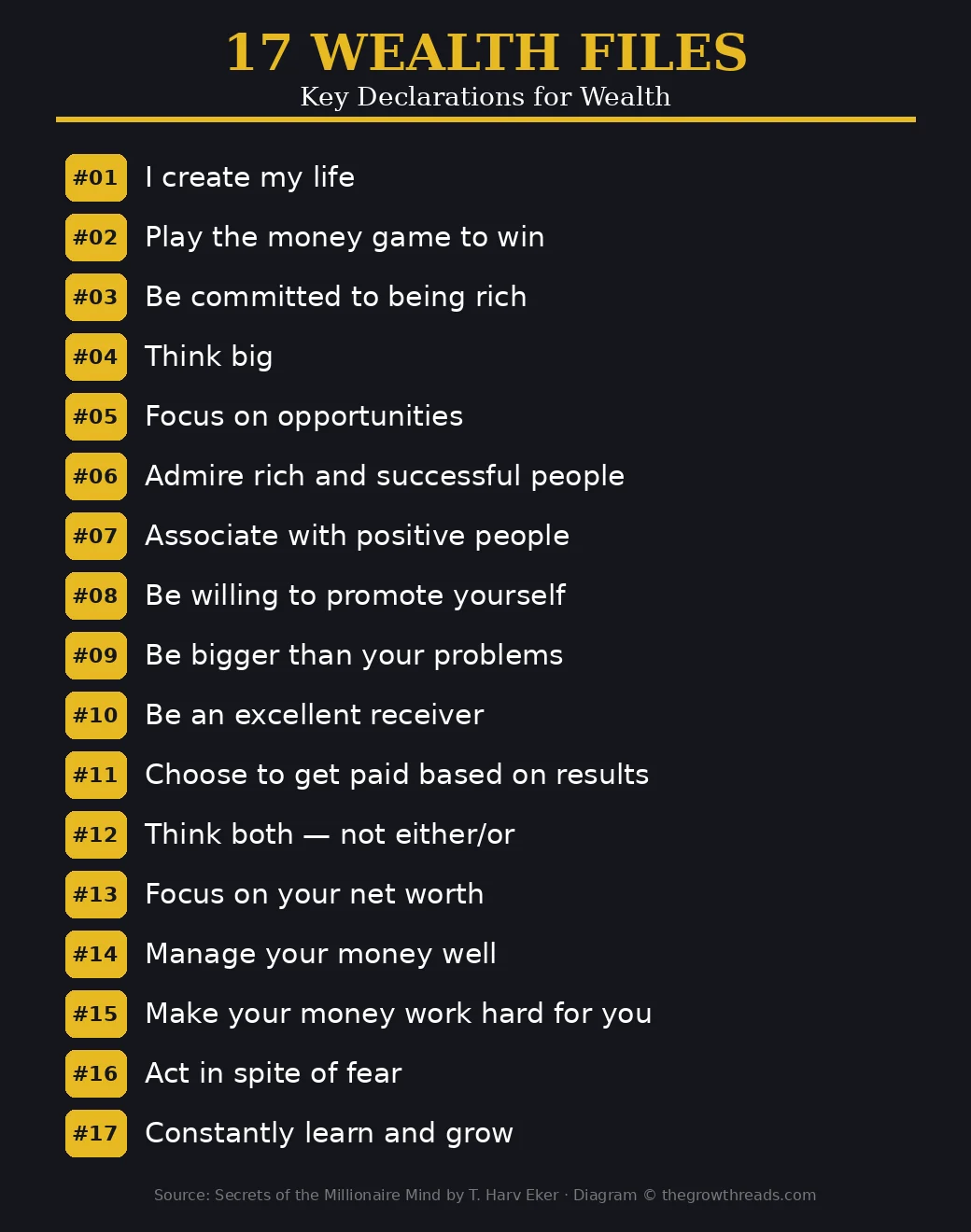
The bulk of the book is organised into 17 “Wealth Files” — paired declarations that contrast the mindset of wealthy people with the mindset of those who struggle financially. Each file follows the same structure: Eker states the contrasting beliefs, tells a story or cites an example to illustrate, then provides a declaration and an action step.
Wealth File #1: “I create my life” vs. “Life happens to me.” Rich people believe they are the drivers of their financial outcomes. They refuse to play victim. When something goes wrong, they ask “What could I have done differently?” rather than blaming the economy, their boss, or their upbringing. Eker notes that victimhood comes in three flavours: blaming, justifying, and complaining — and all three are wealth-killers because they hand control to external forces.
Wealth File #4: “Rich people think big.” Eker argues that your income is directly proportional to how many people you serve and how well you serve them. Thinking small — limiting your vision to just yourself or a handful of clients — mathematically limits your income. Entrepreneurs who build scalable systems, products, or platforms serve millions and earn accordingly.
Wealth File #12: “Rich people think both.” This is one of the book’s most memorable ideas. Average thinkers see the world in either/or: either you are rich or you are happy, either you have money or you have meaning. Wealthy thinkers refuse this false dichotomy. They ask, “How can I have both?” This reframe opens creative solutions that scarcity thinking never sees.
Wealth File #16: “Rich people act in spite of fear.” Eker distinguishes between the zones of comfort, stretch, and die. Growth happens in the stretch zone. Wealthy people feel the same fear as everyone else — fear of failure, rejection, embarrassment — but they have trained themselves to take action anyway. The key insight: the size of the problem is never the issue; the size of you is.
Part 3: The money management system
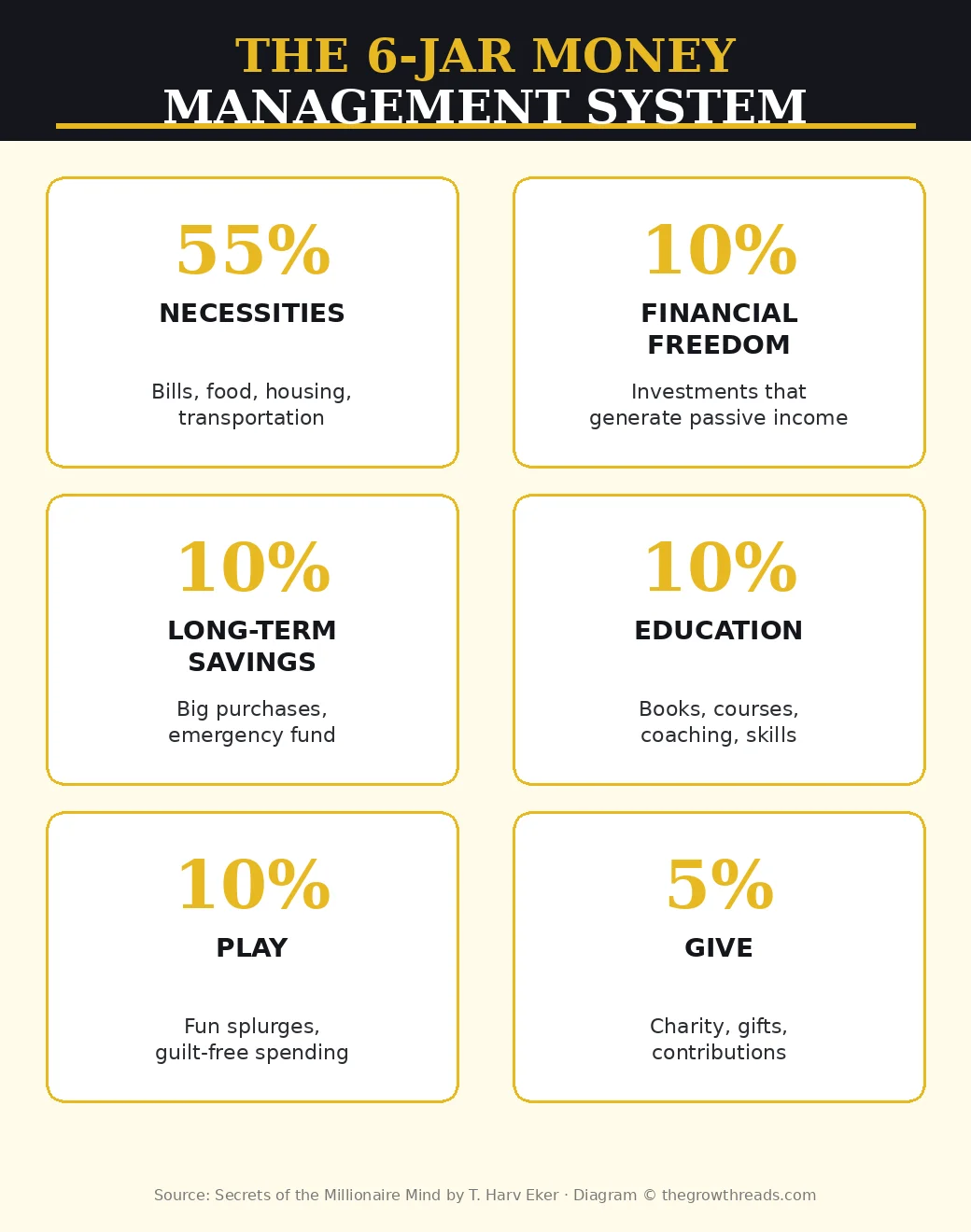
Eker devotes the latter portion of the book to a concrete action system: the six-jar method. The idea is deceptively simple — split every dollar of income into six separate accounts, each with a fixed percentage and a non-negotiable purpose:
Necessities (55%): Rent, bills, groceries, transportation — everything you need to live. If your necessities currently consume more than 55%, Eker says to either increase your income or reduce your lifestyle until you hit the target.
Financial Freedom Account (10%): This is the golden goose. Money in this jar is never spent. It is invested — in index funds, rental properties, business equity — to produce passive income. You touch the eggs (the returns), never the goose (the principal).
Long-Term Savings (10%): For big purchases (a car, a house deposit, an emergency fund). This jar prevents you from raiding the Financial Freedom Account when life throws an expensive curveball.
Education (10%): Books, courses, coaching, seminars. Eker walks the talk here — he spent tens of thousands on personal development before making his first million and considers it the highest-return investment he ever made.
Play (10%): This jar is mandatory, not optional. You must spend it every month on something that makes you feel rich — a fancy dinner, a spa day, an upgrade. The purpose is to counterbalance the discipline of the other jars so you never feel deprived, which is the feeling that causes most budgets to collapse.
Give (5%): Charity, donations, gifts. Eker argues that generosity is a wealth habit, not a luxury to defer until you are rich.
Part 4: Rewiring your blueprint for good
Eker closes by emphasising that awareness alone is not enough — you need practice. He recommends daily declarations spoken aloud with conviction, ideally while touching your head (“I have a millionaire mind”) to anchor the statement physically. He suggests surrounding yourself with people whose financial thermostat is set higher than yours, because proximity is one of the fastest ways to recalibrate your blueprint.
He also warns about what he calls the “smooth-road myth” — the belief that building wealth should feel comfortable. Real financial growth almost always involves discomfort: the discomfort of investing when the market drops, negotiating a higher salary, starting a side business, or saying no to a lifestyle upgrade. Wealthy people have learned to associate this discomfort with progress rather than danger.
Finally, Eker returns to the thermostat metaphor one last time. He points out that most people try to change their results (get a raise, cut expenses, try a new investment) without changing their blueprint. This is like opening the window when the room is too warm — the thermostat will just crank the heater back up. Lasting change requires reprogramming at the belief level, then letting the actions and results follow naturally.
Who is Secrets of the Millionaire Mind best for — and who should read something else first?
This book is ideal for people who have read practical money books (budgeting, investing, saving) but still find themselves stuck in the same financial patterns. If you intellectually know what to do with money but emotionally cannot seem to do it, Eker’s blueprint framework explains the gap. It is also excellent for anyone in their twenties or thirties who wants to identify and dismantle inherited money beliefs before they compound for decades.
If you already have a strong growth mindset and are looking for advanced investment strategy, this book will feel too basic. Try A Random Walk Down Wall Street for evidence-based investing or The Simple Path to Wealth for a streamlined index-fund approach. If you prefer a more research-grounded exploration of money psychology, The Psychology of Money covers similar territory with more nuance and fewer declarations.
Questions to reflect on
- What are the top three phrases you heard about money growing up, and do you still unconsciously believe them?
- If you mapped your parents’ financial habits onto your own, which patterns would overlap?
- What is your current “financial thermostat” set to — and what specific evidence (spending patterns, savings level, career choices) proves it?
- Where in your life are you choosing “either/or” when “both” might be possible?
- What is one financial action you have been avoiding because of fear, and what is the smallest version of that action you could take this week?
🔥 Ready to reset your financial thermostat?
Discover the 17 mindset shifts that separate the wealthy from everyone else.
How to apply Secrets of the Millionaire Mind (7-day plan)
- Day 1 — Audit your verbal programming: Write down every phrase about money you remember hearing from parents, teachers, and media as a child. Circle the ones you still believe.
- Day 2 — Identify your money blueprint: Look at your bank balance, savings rate, and debt level. What “thermostat setting” do these numbers reveal? Write your current setting and your desired setting.
- Day 3 — Write three declarations: Choose three Wealth Files that challenge your current beliefs. Write them as declarations (“I have a millionaire mind,” “I am an excellent receiver”) and say them aloud morning and night.
- Day 4 — Set up the six jars: Open separate bank sub-accounts (or use labelled envelopes) for Necessities, Financial Freedom, Long-Term Savings, Education, Play, and Give. Set the percentages even if the amounts are tiny.
- Day 5 — Split your next income: The very next dollar that comes in, divide it according to the six-jar percentages. Automate where possible.
- Day 6 — Spend your Play jar: Buy something purely for enjoyment — even if it is a $5 coffee upgrade. The goal is to practice guilt-free spending so discipline does not curdle into deprivation.
- Day 7 — Upgrade your environment: Identify one person in your life who has a higher financial thermostat than you. Reach out to schedule a conversation, follow their content, or join a community they recommend.
Frequently asked questions
Is Secrets of the Millionaire Mind worth reading in 2026?
Yes, if you approach it for its core framework rather than its seminar-style delivery. The money-blueprint concept and six-jar system remain practical and widely referenced in personal-finance communities. The mindset material is evergreen — childhood programming around money does not expire. Readers who prefer a more modern tone may want to pair it with The Psychology of Money for a complementary perspective that delivers similar insights through storytelling rather than declarations.
What is the main message of Secrets of the Millionaire Mind?
Your financial life is determined by your subconscious money blueprint — the set of beliefs about wealth you absorbed in childhood. Until you identify and replace the limiting beliefs in that blueprint, no strategy, budget, or income increase will produce lasting wealth. Eker provides 17 contrasting belief pairs (Wealth Files) and a practical money-management system to help readers reprogram their financial thermostat and start building wealth from the inside out.
What is the six-jar money management system?
It is a budgeting method where you split every dollar of income into six purpose-driven accounts: Necessities (55%), Financial Freedom (10%), Long-Term Savings (10%), Education (10%), Play (10%), and Give (5%). The Financial Freedom Account is invested and never spent — its purpose is to grow until it generates enough passive income to cover your expenses. The Play Account ensures you enjoy life now so the system stays sustainable.
What are the 17 Wealth Files?
The Wealth Files are 17 contrasting pairs of beliefs that distinguish wealthy people from those who struggle financially. Examples include: rich people believe “I create my life” while others believe “life happens to me”; rich people “think big” while others “think small”; rich people “focus on opportunities” while others “focus on obstacles.” Each file comes with a declaration to reprogram the limiting belief and an action step to practice the empowering one.
How does Secrets of the Millionaire Mind compare to Rich Dad Poor Dad?
Both books argue that financial success starts with mindset rather than technical knowledge, but they approach the idea differently. Rich Dad Poor Dad uses a narrative framework — two fathers, two money philosophies — and focuses on building assets and financial literacy. Secrets of the Millionaire Mind is more prescriptive: it diagnoses your specific limiting beliefs through the blueprint model and gives you a structured system (six jars, declarations) to change them. Read Rich Dad for the asset-vs-liability distinction; read Eker for the inner reprogramming work.
Does T. Harv Eker have any controversy?
Eker’s live seminars included upsells and high-pressure sales tactics, which drew criticism from some attendees. The book itself, however, stands on its own without requiring any paid programme. The six-jar system and blueprint framework are freely usable, and the core ideas about childhood money conditioning are well-supported by behavioural psychology research. Readers who enjoy the book can apply everything in it without attending a seminar.
How long does it take to read Secrets of the Millionaire Mind?
At 224 pages, most readers finish it in roughly four hours of focused reading. The writing is conversational and repetitive by design (Eker uses declarations and recaps to reinforce each point), so it reads faster than a typical nonfiction book of the same length. Many readers report finishing it in a single weekend. The bigger time investment is the reflection and journaling exercises, which Eker recommends doing alongside each chapter.
Related summaries
- The Psychology of Money Summary — Why personal history shapes financial decisions more than spreadsheets.
- I Will Teach You to Be Rich Summary — A modernised, automation-heavy system for managing money in your twenties and thirties.
- Rich Dad Poor Dad Summary — The asset-vs-liability framework that changed how a generation thinks about money.
- The Total Money Makeover Summary — Dave Ramsey’s debt-elimination playbook for people who need structure and intensity.
- See all money book summaries on our Best Money Books pillar page.
Related Money Summaries
Just Keep Buying Summary & Review: Data-Driven Wealth Building Made Simple
Skin in the Game Summary and Review
The Black Swan Summary and Review
The Little Book That Still Beats the Market Summary and Review
The One-Page Financial Plan Summary & Review: One Honest Page Beats a 40-Page Forecast