

⭐⭐⭐⭐ 4.1 / 5
One-liner: A fascinating tour of the hidden forces that make us predictably irrational — and how to spot them before they steer you wrong.
Best for: Anyone who wants to understand why they overpay, procrastinate, or make decisions they later regret — and what behavioral science says about fixing it.
Reading time: ~6 hours (304 pages)
Difficulty to apply: Moderate — awareness is the first step, but overriding deep biases takes practice.
Predictably Irrational in one minute
You are not the rational decision-maker you think you are — and neither is anyone else. Dan Ariely, a behavioral economist at Duke University, spent decades running clever experiments that reveal how humans systematically misjudge value, fall for “free” offers, let emotions override logic, and procrastinate even when the stakes are high. The good news: because our irrationality follows patterns, we can learn to predict it and design better choices. This book is your field guide to the hidden forces behind everyday decisions — from what you buy to how you negotiate, date, and set goals.
Key takeaways
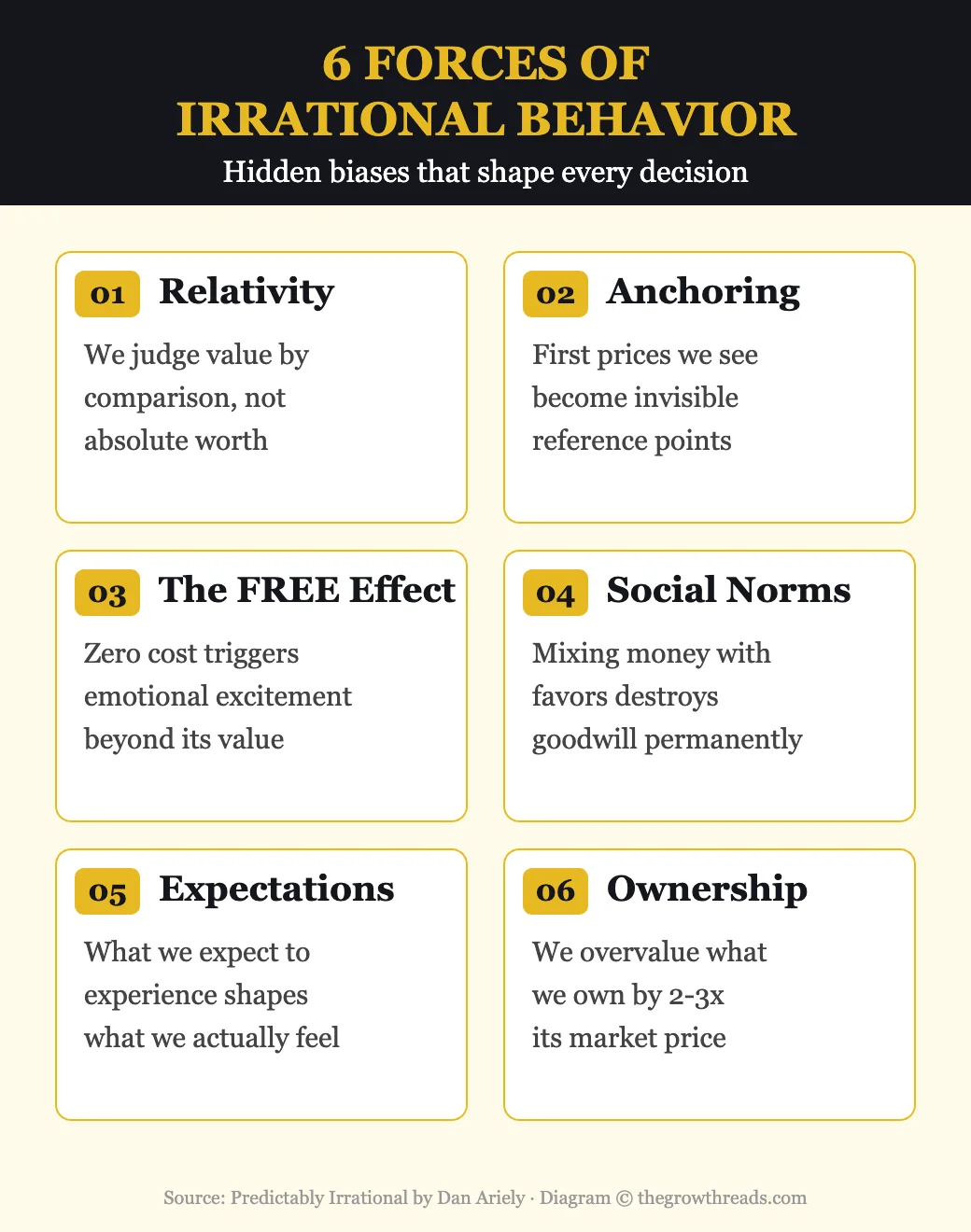
- Relativity drives decisions: We rarely evaluate things in isolation — we compare them side by side, and marketers exploit this by adding decoy options that make one choice look like a clear winner.
- Anchoring shapes prices: The first number you encounter (a listed price, a suggested donation) becomes an invisible anchor that influences every subsequent judgment, even when the anchor is arbitrary.
- FREE is not just a price: Reducing a price to zero triggers an emotional reaction far beyond a simple one-cent discount. We grab free items we do not need and ignore better deals because zero feels risk-free.
- Social and market norms do not mix: Once you introduce money into a relationship built on goodwill — asking a friend to help you move for $20 instead of as a favor — you destroy the social contract and cannot easily rebuild it.
- Emotions override logic in the heat of the moment: When aroused — by anger, hunger, desire, or excitement — people make choices they would never predict from a calm, “cold” state.
- We overvalue what we own: The endowment effect means sellers consistently price their possessions two to three times higher than buyers are willing to pay, simply because ownership creates attachment.
- Expectations shape experience: If you believe a wine is expensive, it genuinely tastes better to you. Expectations are not just predictions — they physically alter perception.
- Procrastination is predictable: Without external deadlines and commitment devices, people reliably delay important tasks even when they know the cost of waiting.
- Honesty is flexible, not absolute: Most people cheat a little when given the chance, but reminders of moral standards (like recalling the Ten Commandments) dramatically reduce dishonesty — even among atheists.
- Awareness is the first step to better decisions: You cannot eliminate every bias, but recognizing when relativity, anchoring, or the free effect is influencing you lets you pause and choose more deliberately.
What is Predictably Irrational about?
Predictably Irrational is a behavioral economics book that uses laboratory experiments and real-world examples to prove that human decision-making is systematically biased, not randomly flawed. Dan Ariely shows that the same cognitive shortcuts — relativity, anchoring, loss aversion, the power of free, and emotional arousal — produce the same mistakes across cultures and contexts, and he offers practical strategies for designing better choices.
About the author
Dan Ariely is the James B. Duke Professor of Psychology and Behavioral Economics at Duke University and the founder of the Center for Advanced Hindsight. Born in New York and raised in Israel, Ariely suffered severe burns covering 70 percent of his body in a magnesium flare explosion at age 18. His three-year recovery in a burn ward — where nurses ripped off bandages quickly despite his pleas to go slowly — sparked his lifelong fascination with how humans perceive pain, make decisions, and behave irrationally. He holds a Ph.D. in cognitive psychology from the University of North Carolina and a Ph.D. in business administration from Duke. His TED talks have been viewed over 20 million times. Explore all Dan Ariely book summaries →
Key concepts at a glance
| Concept | What it means | Use it when |
|---|---|---|
| The Decoy Effect | Adding a clearly inferior third option makes one of the two real options look far more attractive | Pricing products, evaluating subscription plans, negotiating offers |
| Arbitrary Coherence | Once we anchor to a random first price, all future prices feel coherent relative to it | Setting or evaluating prices, salary negotiations, bidding |
| The Cost of Zero Cost | Free triggers an emotional rush that overrides rational cost-benefit analysis | Evaluating promotions, designing offers, avoiding impulse grabs |
| Social vs. Market Norms | Relationships operate in social mode (favors) or market mode (transactions) — mixing them backfires | Managing teams, designing compensation, asking for help |
| The Effect of Expectations | What we believe about a product physically alters our experience of it | Branding, placebos, setting customer expectations |
| The Endowment Effect | Ownership makes us value things 2–3x more than non-owners do | Negotiation, selling a house, free trials, returns policy |
| The Problem of Procrastination | Without pre-commitment, we reliably choose short-term comfort over long-term gain | Setting deadlines, building habits, financial planning |
| The Context of Character | Most people cheat a little; moral reminders and removing cash reduce dishonesty | Designing ethical systems, auditing, self-regulation |
Part 1 — The truth about relativity and anchoring
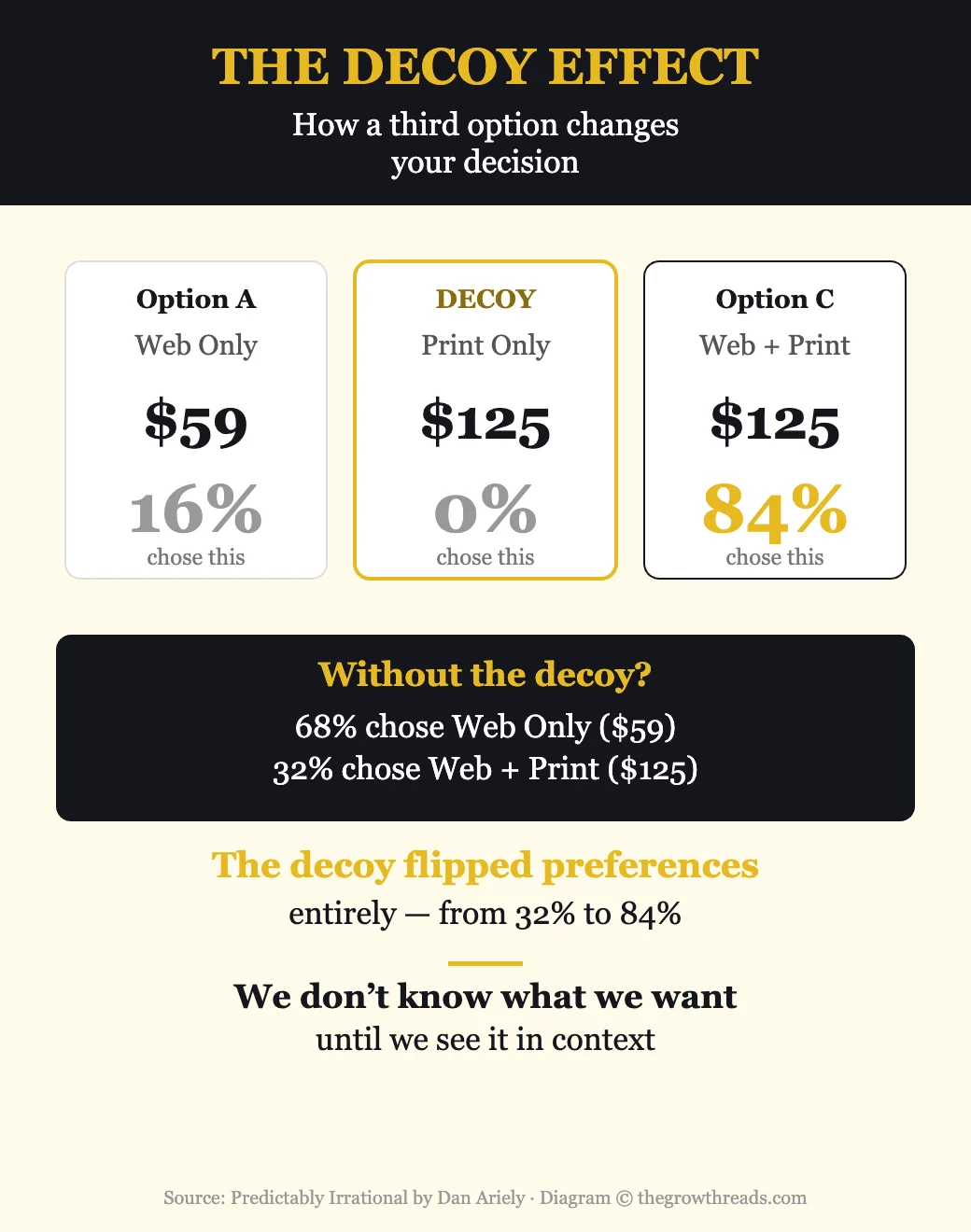
Ariely opens with what he calls the truth about relativity — not Einstein’s version, but the psychological kind. We almost never evaluate things in a vacuum. Instead, we compare options side by side, and the mere presence of a third, inferior option (a decoy) can flip our preference entirely.
His famous Economist subscription experiment makes this vivid. When students were offered just two options — web-only for $59 or web-plus-print for $125 — most chose the cheaper web-only deal. But when Ariely added a third option — print-only for $125 (identical in price to web-plus-print but clearly worse) — suddenly 84 percent of students chose web-plus-print. The decoy made the combo deal look like a bargain by comparison, even though its price had not changed.
Ariely then introduces arbitrary coherence — the idea that the first price we encounter for a product, even if it was random, becomes the anchor for all future prices. In one study, he had students write down the last two digits of their Social Security number, then bid on items like wine and chocolate. Students with high Social Security numbers bid up to 346 percent more than those with low numbers. The anchor was meaningless, yet it shaped perceived value for every item afterward.
The practical takeaway is unsettling: your sense of fair price may have been set by the first number you saw, not by any genuine assessment of value. Ariely recommends questioning your first impressions of cost and resisting the urge to compare — especially when a seller has arranged the options for you.
Part 2 — The power of free and social norms
Ariely devotes an entire chapter to what he calls the cost of zero cost. In an experiment with Lindt truffles and Hershey’s Kisses, he showed that when a truffle cost 15 cents and a Kiss cost 1 cent, 73 percent of people chose the objectively better truffle. But when both prices dropped by one cent — truffle at 14 cents, Kiss now free — 69 percent switched to the Kiss. The rational calculation had not changed (the price difference remained the same), yet free created an emotional surge that overwhelmed logic.
This finding has enormous implications for marketing, public policy, and personal finance. Free shipping thresholds, buy-one-get-one offers, and zero-percent financing all exploit the fact that zero is not just another number — it is an emotional trigger. Ariely advises pausing whenever you encounter a free offer and asking: would I still want this if it cost one cent?
The next major insight concerns social versus market norms — the two operating systems of human exchange. Social norms govern relationships (helping a friend move, bringing wine to a dinner party). Market norms govern transactions (paying a contractor, negotiating a salary). Ariely’s experiments reveal that mixing the two is catastrophic. When he offered people a small cash payment for performing a task, they worked less than when they received no payment at all. A gift of the same dollar value, however, worked beautifully — because gifts live in the social-norms world.
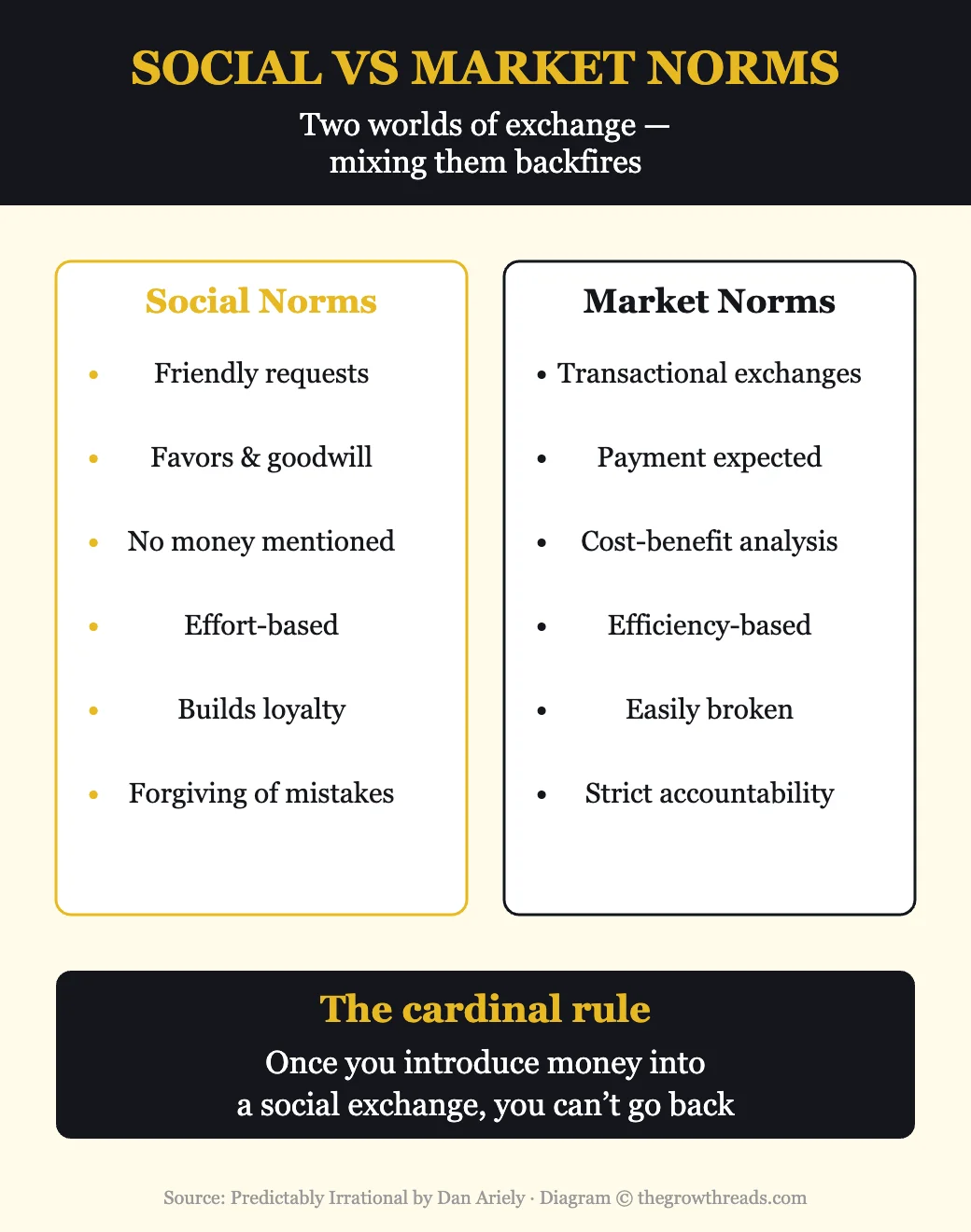
The critical warning: once money enters a social relationship, it is nearly impossible to return to social norms. Offering your mother-in-law $50 for Thanksgiving dinner does not just fail — it damages the relationship in ways that cannot be undone by simply stopping the payments. Companies that want loyal employees, Ariely argues, should emphasize social rewards (purpose, belonging, flexibility) rather than relying solely on bonuses, because the moment workers start thinking in pure market terms, they will also leave in market terms — for the next highest bidder.
Part 3 — Expectations, ownership, and the hot-cold empathy gap
The middle section of the book explores how expectations shape reality and how emotions hijack reason. In a beer-tasting experiment, Ariely added a few drops of balsamic vinegar to a craft brew. When tasters were told about the vinegar before drinking, they rated the beer poorly. When they tasted it blind (without knowing about the vinegar), they liked it. Expectations did not just influence opinion — they changed the sensory experience itself.
He extends this to the placebo effect: more expensive placebos produce stronger effects than cheaper ones, even when both are sugar pills. A $2.50 placebo reduced pain for 85 percent of participants; the same pill priced at 10 cents helped only 61 percent. The implication for healthcare, branding, and consumer behavior is profound — price is not just a signal of quality; it becomes part of the experience.
Ariely then turns to ownership bias. In a study of Duke University basketball tickets (notoriously hard to get), students who had won tickets in a lottery valued them at roughly $2,400, while students who had not won offered only $170 on average. The gap — a factor of 14 — illustrates how powerfully ownership distorts perceived value. This endowment effect explains why sellers in every market — from eBay to real estate — consistently overprice their items.
One of Ariely’s most provocative chapters examines what he calls the hot-cold empathy gap. Using a laptop-based survey, he asked male college students to predict their behavior during sexual arousal — would they use a condom, would they pressure a partner? In a calm state, students made responsible predictions. When genuinely aroused, they were 25 to 136 percent more likely to say they would make risky or unethical choices. The lesson: we cannot predict our hot state behavior from a cold state. Planning for temptation must happen before it arrives — through pre-commitment devices, environmental design, and habit structures.
Part 4 — Procrastination, honesty, and designing better choices
Ariely’s experiments on procrastination are among his most cited. He gave three sections of the same university course different deadline structures. One group had a single end-of-semester deadline. Another received evenly spaced deadlines set by the professor. A third group chose their own deadlines (with grade penalties for missing them). The results: students with externally imposed deadlines performed best. Self-set deadlines came second. And the group with total freedom — a single final deadline — performed worst, turning in lower-quality work and earning lower grades.
The takeaway is counterintuitive: freedom can be a liability. When we have the option to delay, we reliably will. Pre-commitment — setting binding deadlines, automating savings, scheduling workouts in advance — is not a crutch. It is a rational response to a predictable flaw.
The book closes with a nuanced exploration of honesty. In a series of experiments, Ariely found that most people cheat — but only a little. Given a chance to overreport their scores on a test for money, participants typically inflated their results by a small amount, not the maximum possible. Surprisingly, increasing the potential reward did not increase the amount of cheating. But when Ariely removed cash from the equation — having people cheat for tokens that were later exchanged for money — dishonesty increased. The psychological distance from actual currency made cheating feel less like stealing.
Most remarkable: when participants were asked to recall the Ten Commandments before the test, cheating dropped to zero — regardless of the students’ religious beliefs. The mere act of thinking about a moral code activated an internal honesty switch. Ariely’s conclusion is not that people are fundamentally dishonest but that the context of a decision — the environment, the distance from money, the presence or absence of moral reminders — has far more influence on ethical behavior than personal character does.
Who is Predictably Irrational best for — and who should read something else first?
This book is ideal for curious readers who want an accessible, experiment-driven introduction to behavioral economics. If you are a marketer, product designer, manager, or anyone who designs choices for others, the frameworks here — decoys, anchoring, social norms — are immediately applicable. Entrepreneurs will find the pricing and free-offer chapters especially useful.
If you are looking for a deeper, more systematic treatment of the cognitive science behind these effects, start with Thinking, Fast and Slow by Daniel Kahneman. If you are more interested in the persuasion side — how these biases are used on you — Influence by Robert Cialdini is the better entry point. And if you want a pure self-improvement angle (changing your own habits rather than understanding biases), try Atomic Habits by James Clear.
Questions to reflect on
- Think of your last major purchase. What was the anchor price — and was it set by you or by the seller?
- Have you ever taken something simply because it was free, even though you did not need it? What was the real cost (time, clutter, calories)?
- In which relationships have you accidentally introduced market norms — and how did the dynamic change afterward?
- When you are in a hot emotional state (angry, excited, hungry), what decisions do you tend to make that your calm self would disagree with?
- What commitment devices could you set up today — deadlines, automatic transfers, scheduled appointments — to protect yourself from predictable procrastination?
🔥 Ready to outsmart your own brain?
Learn the hidden forces that shape your decisions — and design better ones.
How to apply Predictably Irrational (7-day plan)
- Day 1 — Anchor audit: Write down three prices you consider normal (coffee, gym, streaming). Research when you first encountered those prices. Are they anchors from years ago, or reflections of current value?
- Day 2 — Free filter: Track every free offer you encounter today (samples, downloads, trials). For each one, ask: would I pay $1 for this? If not, skip it.
- Day 3 — Decoy detector: The next time you are choosing between options (plans, menu items, products), look for the decoy — the option that seems to exist only to make another one look better. Choose as if the decoy were not there.
- Day 4 — Social norms check: Identify one relationship where you may have introduced market norms (paying a friend for help, charging family for advice). Consider how to shift it back toward social norms with a gesture of goodwill.
- Day 5 — Pre-commitment device: Pick your biggest procrastination problem right now. Set a binding external deadline — tell a friend, schedule a meeting, or automate the first step so it happens without your willpower.
- Day 6 — Expectation reset: Try a blind test: taste a store-brand product next to a premium one without looking at the labels. Notice whether your experience changes when branding is removed.
- Day 7 — Ownership check: Look at something you own that you have been meaning to sell. Estimate its value. Then check what similar items actually sell for online. Notice the gap — that is the endowment effect in action.
Frequently asked questions
What is the main idea of Predictably Irrational?
The central thesis is that humans are not randomly irrational — they are predictably irrational. The same cognitive biases (relativity, anchoring, the power of free, social norms, the endowment effect, and emotional arousal) produce the same kinds of mistakes across all people and situations. Because these patterns are systematic, we can study them scientifically and design environments — through pre-commitment, awareness, and choice architecture — that help us make better decisions despite our innate biases.
Is Predictably Irrational based on real research?
Yes. Nearly every chapter is built around controlled experiments — many of them conducted by Ariely and his colleagues at MIT, Duke, and other universities. The studies on the decoy effect, the cost of zero cost, Social Security number anchoring, and the honesty experiments have been published in peer-reviewed journals. Ariely supplements his own data with studies from other leading behavioral economists and psychologists, making this one of the more evidence-rich popular science books in the field.
How is Predictably Irrational different from Thinking, Fast and Slow?
Both books cover cognitive biases, but they differ in scope and depth. Kahneman’s Thinking, Fast and Slow is a comprehensive theory of two cognitive systems (fast intuition vs. slow deliberation) and spans decades of research. Ariely’s book is more focused and accessible — it zeroes in on specific decision traps in commerce and daily life, with shorter, story-driven chapters. Think of Kahneman as the textbook and Ariely as the field guide. Many readers benefit from reading Ariely first, then Kahneman for the deeper framework.
What is the decoy effect in Predictably Irrational?
The decoy effect (also called asymmetric dominance) occurs when a third, inferior option is added to a choice set, making one of the original two options look much better by comparison. Ariely demonstrated this with The Economist’s subscription pricing: adding a print-only option at the same price as web-plus-print made the combo deal feel like a steal, shifting preferences from 32% to 84%. The decoy exists not to be chosen but to steer you toward the seller’s preferred option.
Can you really overcome irrational behavior after reading this book?
Awareness helps, but it is not a cure. Ariely is candid that knowing about biases does not automatically neutralize them — even behavioral economists fall for anchoring and the endowment effect. The real value is in designing systems and environments that account for irrationality: pre-commitment devices for procrastination, cooling-off periods before purchases, removing decoys from your own decision-making, and keeping social and market norms separate. The book gives you the diagnostic; applying the fix takes deliberate practice.
Is Predictably Irrational still relevant in 2026?
Absolutely. The cognitive biases Ariely describes are hardwired features of the human brain, not cultural trends. If anything, the book has become more relevant as digital marketing, subscription pricing, and app design have become more sophisticated at exploiting these exact patterns. The free-offer chapter reads like a playbook for modern freemium business models. Some specific experiments have been debated in the replication crisis, but the core findings — anchoring, the free effect, social norms — have held up well across follow-up studies.
What should I read after Predictably Irrational?
For the deeper cognitive science behind these biases, read Thinking, Fast and Slow by Daniel Kahneman. For the persuasion and influence angle, try Influence by Robert Cialdini. If you want to apply behavioral insights to habit change, Atomic Habits by James Clear is the natural next step. And for a broader look at how environment shapes behavior, The Power of Habit by Charles Duhigg connects directly to Ariely’s pre-commitment ideas.
Related summaries
- Thinking, Fast and Slow by Daniel Kahneman — the foundational framework behind the biases Ariely describes.
- Influence by Robert Cialdini — how these biases are weaponized in persuasion and sales.
- Emotional Intelligence by Daniel Goleman — the role of emotions in rational decision-making.
- Best Psychology Books — our complete guide to the most impactful psychology reads.